Early in the morning, a Meta employee opened his work computer as usual.
He noticed something new installed in the system.
No pop-up notification, no permission request. A program called MCI was already recording every mouse movement, every click, every keystroke, and occasionally even taking screenshots.
There was only that lightly worded notice in an internal memo: “This tool will record your mouse movements, clicks, and keystroke activity within work applications.”
He froze for three seconds.
Not because of the monitoring itself—what big tech company in Silicon Valley doesn’t monitor? But because he suddenly remembered another sentence from an all-hands email two weeks earlier: “Starting May 20, the company will reduce approximately 8,000 positions.”
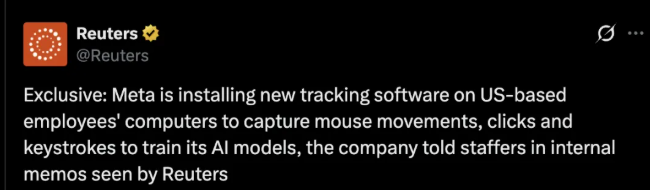
A memo obtained by Reuters states clearly: the data collected by MCI will be used to train AI agents capable of “autonomously executing work tasks.”
Forcing tracking in the name of AI training
Meta has really gotten anxious.
To catch up on AI progress, they’ve already started forcing employees to “skill-ify” themselves.
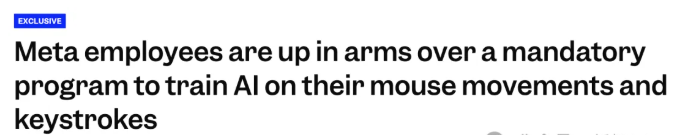
An internal announcement just came out. Officially it’s “for training AI,” but in reality, they are going to mandatorily monitor employees’ mouse movements and keyboard inputs.
In other words, every move Meta employees make will become training fuel for AI.
Building AI isn’t enough anymore—this is basically teaching AI, step by step, how to replace you.
And there’s no opt-out, no choice.
Under the internal post, it’s full of crying, shocked, and angry emojis from employees.
A highly upvoted comment said: “This makes me very uncomfortable. How can we opt out?”
But the answer is simple—there is no opt-out.
Meta’s attitude is clear: no discussion.
Your work has already become training data
MCI stands for “Model Capability Initiative.”
One line in the memo is especially striking: “This is precisely an opportunity for all Meta employees to help our models improve through their everyday work activities.”
Translated into plain language—your work itself has already become training data.
This is no longer basic monitoring. It goes deeper, into how humans actually think and operate.
When you fix a complex bug, MCI doesn’t just record the result. It records how you click, how you backtrack, how you compare across windows.
Every shortcut key is a decision. Every mouse path is a judgment.
Meta is turning this kind of tacit knowledge—things that used to live only in your brain—into structured data that AI can learn from.
This is a very direct kind of behavior cloning.
Employee data becomes the perfect AI dataset
Honestly speaking, nothing feeds AI better than employees’ own operational data.
High quality, high density, fully real.
Other companies probably want this too. But being this direct about taking it, Meta is the first.
According to the internal announcement, the tracking tool will be force-installed on employee computers.
It can capture mouse movement, click positions, keyboard input, even screen content—basically very private data.
The scope is limited to commonly used work software like Gmail, GChat, Metamate, and VSCode. It only applies to computers, not phones.
All of this data will be used to train new AI models, helping agents understand how humans use computers.
So every employee, just by doing daily work, is helping improve the model.
“AI Builders”: roles are being rewritten
Meta is also changing what jobs even mean.
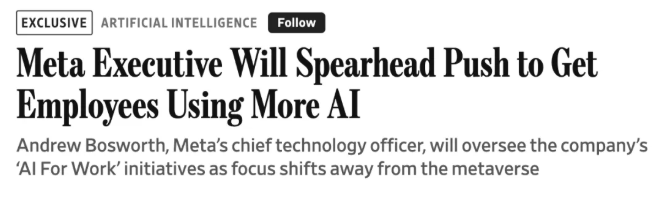
Engineers, product managers, designers—these titles are slowly being replaced by one label: “AI Builder.”
A new “Applied AI” team has already been formed to improve AI coding ability, aiming to let agents handle most of the work—building, testing, deploying.
Only “strong” engineers are being moved into this team.
What about everyone else? The answer is already implied.
The company vision is also shifting: AI does the work, humans direct and review.
But how long will “review” still be needed?
Even Zuckerberg is “self-distilling”
It’s not just employees.
Reports say Mark Zuckerberg has already fed his own speech and behavioral data into AI, trying to create a “Zuckerberg clone” that can interact with employees 24/7.
From the boss down to employees, everyone is being turned into data.
In a way, this is a kind of digital immortality.
But also a kind of replacement.
Internal backlash, external jokes
Inside Meta, backlash is immediate.
Outside, people are joking.
Some netizens even suggested: just spend a few hours at work playing Pac-Man every day—let the AI learn that instead.
“Make Meta Great Again.”
Sounds ridiculous, but also… not entirely impossible.
AI KPI pressure is already here
At the same time, Meta has already tied employee performance tightly to AI.
Using AI tools, building AI features, improving productivity with AI—these now directly affect evaluations and rewards.
And now, even your raw operational data is being “skill-ified.”
Suddenly, those high salaries don’t feel that attractive anymore.
Being a Silicon Valley employee is hard.
Being a Meta employee is even harder.
The bigger picture: Meta is just the beginning
Meta says this data won’t be used for performance evaluation.
That may even be true.
Because once your value is extracted as training data, performance doesn’t really matter anymore.
The company isn’t evaluating you.
It’s replicating you.
And Meta is not alone.
Across the industry, companies are pouring billions into AI—not just to build models, but to learn how humans work.
The direction is very clear: learn the workflow, then take over the workflow.
Your operation trace is your epitaph
The memo also mentions a key goal: let AI discover where humans intervened, so it can do better next time.
That’s the real point.
AI doesn’t just learn your job.
It learns where you correct it—and then learns to not need your correction.
Every time you help AI improve, you move one step closer to being replaced.
This might be the first time in history where:
Working harder and keeping your job are no longer the same thing.
They are starting to point in opposite directions.
And Meta is just the first to make it this obvious.