Over the past few weeks, Reddit has quietly become the best early signal for how Qwen 3.6 performs in the real world — not benchmarks, not launch blogs, but messy, hardware-constrained, toolchain-dependent usage.
Across r/LocalLLaMA, r/LocalLLM, and r/Qwen_AI, one pattern stands out:
People aren’t asking “Is it smart?” anymore.
They’re asking: “Can I actually use this for real work without wasting time?”
This article distills those discussions into concrete, experience-backed insights — with real setups, real numbers, and real tradeoffs.
The Breakthrough Isn’t Intelligence — It’s Reduced Friction
For years, local models have suffered from a hidden tax:
- They can generate code
- But you spend more time fixing, formatting, debugging, and steering
- Net result: slower than doing it yourself
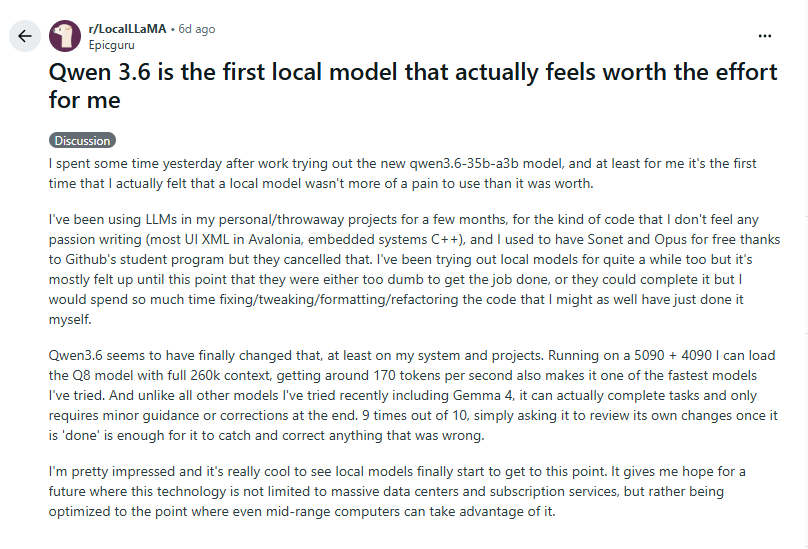
One Reddit user summarized the shift with Qwen 3.6:
“This is the first time the benefit outweighs the effort.”
Real Use Case: “I Just Don’t Want to Write This Code”
- User: Solo developer / student
- Tasks: Avalonia UI XML, embedded C++
- Modèle: Qwen3.6-35B-A3B
- Avant:
- Local models = constant fixing
- Output required heavy manual cleanup
- Après:
- Acceptable outputs with minimal correction
- Used specifically for “boring but necessary” code, shifting the paradigm du « vibe coding » au « wish coding ».
Key Insight:
Users don’t need perfection — they need less rework.
This is the first time a local model crosses that threshold consistently.
Real Performance: Not Benchmarks — Actual Hardware Results
Reddit threads are full of something far more valuable than leaderboard scores: real hardware telemetry.
High-End Setup (RTX 5090)
- Modèle: Qwen3.6-35B-A3B (GPTQ Int4 / NVFP4)
- Vitesse: ~205 tokens/sec
- Context: ~125K
- Cas d'utilisation: Coding + agent workflows
“Absurdly fast for coding.”
What Changed?
Avant :
- You chose between:
- Fast (small models)
- Smart (large models)
Après :
- Qwen 3.6 hits a usable balance
Mid/Old Hardware (8+ Year Old Machine)
- VRAM: 11 GB
- RAM: 64 GB
- Vitesse: ~29 tokens/sec
- Context: Full
This is critical.
Aperçu :
Qwen 3.6 isn’t just scaling up — it’s scaling down usability.
Agent Workflow Throughput
- Environment: Hermes-Agent
- Observed speed: 100+ tokens/sec
“Watching it run at 100+ tok/s is kind of insane.”
This matters because:
👉 In agent workflows, throughput > raw intelligence
27B vs 35B-A3B: Bigger Isn’t Always Better
One of the most detailed Reddit comparisons tested:
- Qwen3.6-27B
- Qwen3.6-35B-A3B
- Qwen3.5-27B
- Gemma 4
Real Task: Writing a Master Architecture Plan
Results (User Ratings):
- Qwen3.6-27B → 9.3 (Best practical default)
- Qwen3.6-35B-A3B → 9.2 (More expansive)
- Gemma 4 → 8.9
- Qwen3.5-27B → 8.8
The Key Difference
| Modèle | Role |
|---|---|
| 27B | Reliable “daily driver” |
| 35B-A3B | Idea expander / structure generator |
“35B is like a resource mine. 27B is what I’d actually use daily.”
Analyse
Users are no longer picking models by size.
They’re picking by job role:
- Editor
- Generator
- Planner
- Expander
That’s a major shift in how local AI is used.
Agent Compatibility Is Where Qwen 3.6 Really Wins
One of the most advanced Reddit tests ran Qwen 3.6 across 5 agent frameworks:
- Hermes Agent
- PydanticAI
- LangChain
- smolagents
- OpenClaude / Anthropique SDK
Key Results (Qwen 3.6 35B, 4-bit)
- Tool calling success: 100%
- Vitesse: ~100 tok/s
- Context: 262K
- Memory footprint: ~20GB
Ce que cela signifie
Most models fail not because they’re dumb, but because:
- Tool calls break
- Formats mismatch
- Agents stall mid-task
Qwen 3.6 shows strong cross-framework reliability.
But There’s a Catch
Even here, users had to:
- Add runtime guards
- Inject tool usage instructions (80–150 tokens)
- Build custom parsing layers
Aperçu :
The model is good — but the system around it still matters just as much.
The Hidden Bottleneck: Not the Model — The Harness
One of the most important (and underrated) Reddit insights:
People are getting better results not by changing models — but by changing the agent scaffolding.
Real Engineering Adjustments
Developers reported adding:
- Runtime guards
- Thinking budgets
- Tool usage injection
- Structured parsing layers
Résultat :
👉 Qwen 3.6 becomes competitive with cloud coding agents, entering the arena of ChatGPT Codex contre Claude Code.
Example: Tool Injection
- Adds 80–150 tokens per step
- Improves:
- Tool reliability
- Execution consistency
Analyse
We’re entering a new phase:
The bottleneck is no longer just the model —
it’s the runtime system design.
Where It Still Breaks (And Why That Matters)
Despite the excitement, Reddit users were very clear about limitations.
1. Tool Calling Can Still Stall
- Model sometimes stops mid-process
- Requires manual “continue”
👉 Breaks full automation loops
2. Memory & Context Tradeoffs (Especially on Mac)
Example:
- Device: M2 MacBook Pro (32GB)
- Needed to reduce context to 32K to avoid OOM
- Recommended: 128K for complex tasks
👉 “Runs” ≠ “runs well”
3. Quantization Tradeoffs
- 4-bit versions show:
- Lower benchmark scores
- Instability in some tasks
4. Framework Sensitivity
Performance varies depending on:
- Tool format (XML vs JSON)
- Framework behavior
- Parser design
Analyse
Qwen 3.6 is not plug-and-play.
C'est plug-and-engineer.
Pricing Perception: Competing With Closed Models?
Reddit reactions to Qwen 3.6 API pricing were split:
- Some: “Why is this priced near Anthropic?”
- Others: “It’s still cheaper than Opus.”
What This Reveals
Users are no longer comparing Qwen to:
- Open models
They’re comparing it to:
- Claude (often benchmarked against Claude Opus 4.7)
- Grok
- Top-tier closed systems
Analyse
Qwen 3.6 is crossing a psychological boundary:
👉 From “open-source alternative”
👉 To “serious competitor”
The Bigger Shift: Local AI Is Becoming Workflow-Ready
Across all threads, one pattern is clear:
Users are no longer experimenting.
They are:
- Running real coding tasks
- Building agent pipelines
- Writing architecture documents
- Testing production workflows
The Old Reality
- Local AI = hobby
- Too much friction
- Not worth it
The New Reality (Qwen 3.6 Era)
- Viable for:
- Coding
- Planning
- Agent workflows
- Still requires setup
- But finally worth the effort
Qwen 3.6 FAQ: Real Questions Answered
Can Qwen 3.6 handle real coding tasks?
Yes, especially for structured and repetitive coding. Complex workflows require proper setup.
Why does tool calling sometimes stop?
Usually due to runtime or parsing issues. Adding guardrails improves stability.
Is 32GB RAM sufficient?
Yes, but may require reducing context size, which impacts performance.
Which model should I choose: 27B or 35B?
- 27B for daily work
- 35B for planning and expansion
Does quantization affect performance?
Yes. Lower-bit models are faster but less stable.
Which frameworks work best?
Structured frameworks like PydanticAI perform reliably; simpler frameworks are more tolerant.
Can it replace cloud models?
In some workflows, yes. For advanced reasoning, cloud models still lead.
Is it suitable for research workflows?
Partially. Larger models perform better, but results vary.
Should I upgrade hardware or optimize setup?
Optimizing your agent setup often delivers greater gains.
How does it compare to Qwen 3.5?
Qwen 3.6 improves usability, especially in agent workflows.
Conclusion finale
Qwen 3.6 doesn’t win because it’s the smartest model.
It wins because:
For the first time, a local model reduces more work than it creates.
That’s the threshold that matters.
And based on Reddit’s early signal:
👉 We’ve just crossed it.