Sheru Bhai, the Lion-Boss Meme, Now Has Its Own AI Video Studio
The lion-headed meme character spreading across Indian and Pakistani short video now has a dedicated generator: 13 boss scenes, 4 locked looks, Kling 4.0 and Seedance 2.0 underneath, and one-time credit packs.
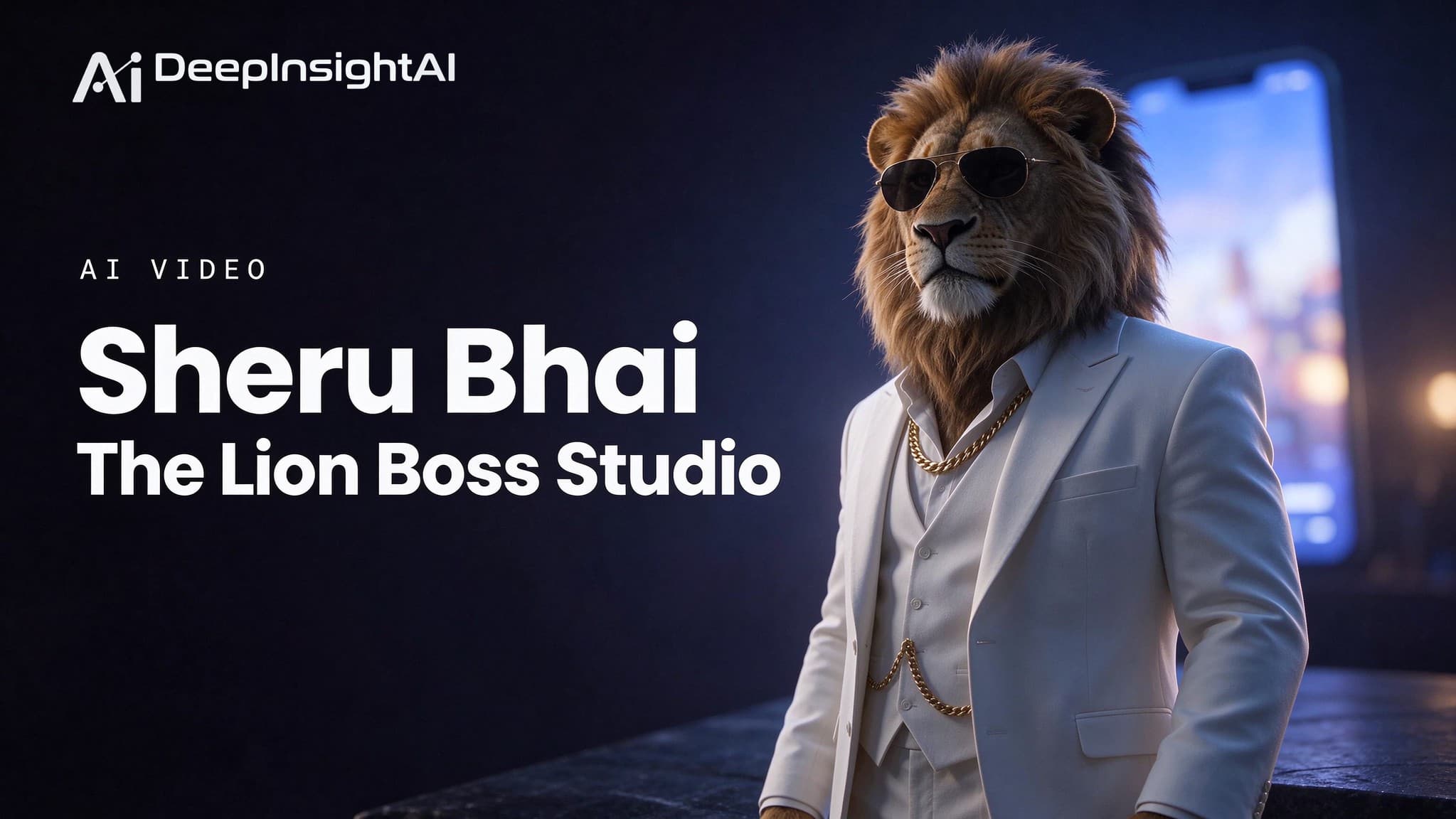
In late 2026 a lion-headed man in a white three-piece suit started appearing in Indian and Pakistani Instagram Reels and YouTube Shorts. He buys whole schools for his son, outbids rooms full of tycoons, and clears a crowded police station with one calm line of Hindi. He has a gold chain, aviator sunglasses, a monkey sidekick named Chintu, and a meme net worth quoted at "$999 trillion."
He is not a person. Sheru Bhai — "sher," lion, plus "bhai," brother — is a fictional AI-generated character, and as of this week he has a dedicated generation studio behind him rather than a scattered set of prompt tutorials. Sheru Bhai AI Video now ships 13 pre-built boss scenes, four locked character looks, and a prompt box that takes a line of dialogue and returns a 9:16 reel with voice and sound.
A Meme Character Nobody Owns
The character's origin is the unusual part. According to the studio, no single creator or label holds him: the lion-boss persona spread across short-video platforms as a community format, which is why anyone can direct their own episode of him. That is a different ownership situation from a licensed character, and it explains both the speed of the trend and the speed with which tooling around it appeared.
The economics follow from the format. A Sheru Bhai reel is a single beat — an entrance, a flex, a one-line threat delivered in Hindi — which is short enough that a template plus one line of dialogue covers most of the creative work. What used to require a prompt-writing session, a text-to-speech pass, and manual lip-sync in an editor collapses into one form.
What the Studio Actually Ships
The scene list is deliberately narrow, and the narrowness is the product. Thirteen sets cover the meme's recurring situations: Boss Convoy Walk, Palace Gate Entry, The Auction, Police Station Silence, School for My Son, Return to the Village, Birthday Gift, Private Jet Chai, Rain Walk, Obsidian Gold Throne, Skyscraper Helipad Arrival, Street Chai & Gold Lambo, and Royal Baraat Wedding Entry. Each arrives with a signature Hindi line already written — "Pehle gaadi dekho, phir baat karo," read as "look at the car first, then talk to me."
Character consistency is handled by four fixed looks — White Boss, Golden Don, Maharaja and Cartoon — rather than by describing the character in a prompt each time. Voice options are Hindi, Hinglish, Urdu, English, or music only. Output defaults to 9:16 at 720p with durations of 5, 8 or 10 seconds; 16:9 and 1:1 are also available.
The model stack is a mix of Chinese and Western vendors, and the studio lists them openly: Kling 4.0 from Kuaishou and Seedance 2.0 from ByteDance for video generation with native voice and sound, plus Nano Banana 2 from Google, Seedream 5.0 Lite from ByteDance and GPT Image 2 from OpenAI for the still portraits and wallpapers. Listing the underlying models this plainly is rarer than it should be in a category where most tools describe their engine only as "AI."
Putting Yourself in the Frame
The feature most likely to drive adoption is the one that breaks the fourth wall. "Me as Sheru Bhai" takes a single selfie, keeps the uploaded framing, build and posture, and either transforms the user into the white-suited lion boss or places them shoulder to shoulder with him in a palace lobby. Uploaded selfies are deleted after 24 hours, and the studio says the expiry is enforced on its own storage rather than promised in policy language.
Alongside it sits a still-image side of the product: Sheru Bhai AI photo generates HD portraits and 9:16 wallpapers in the same four looks, each of which can be animated into a one-tap video. The split is sensible — the photo is the cheap, fast artifact, and the video is the one that gets posted.
Pricing: Packs, Not Subscriptions
The billing model is one-time credit packs with no recurring charge: 400 credits for $4.90 (₹399 via UPI), 1,400 for $14.90 (₹1,199), and 4,200 for $39.90 (₹2,999). Paid credits carry no expiry, work across every tool on the site, and include a commercial-use license. New accounts get 10 free credits valid for three days, which is enough to produce one short test reel rather than a series.
The credit math is worth reading before buying, because it depends on the settings. The site's own estimate puts a 400-credit pack at roughly five 5-second 480p videos or about forty AI images — and its reference row for Kling 4.0 lists a rate "from 48 credits per second." Higher resolution and longer durations move that total quickly. Failed generations are refunded automatically, and there is a 14-day refund window.
The Claim Worth Checking
The studio's pitch compares itself to the manual route most creators were using until now: write the prompt, generate the character, run text-to-speech, sync the lips in an editor. Its table puts a 9:16 reel at one to three minutes against 30 to 60 minutes for the four-app method, and notes that render times vary with queue load. That claim is plausible for a template-driven workflow and untested by us; the honest reading is that the template removes the prompt engineering and the sync, not the generation time itself.
Two things the product does not settle. First, a 720p default is fine for Reels and Shorts and marginal for any larger placement, and the four fixed looks mean every creator's lion boss is the same lion boss — the price of consistency. Second, "no official owner" is a description of the meme's spread, not a legal opinion about the character. Creators posting a lion-headed billionaire are advised to treat the likeness as community folklore and their own lines as their own legal exposure, which is exactly how the studio's own FAQ puts it.
Why This Matters Beyond One Meme
Sheru Bhai is a small but clean example of a shift in how AI video tools get built. The general-purpose text-to-video product asks the user to describe a world. This asks the user to type one line of dialogue into a world that already exists and is already recognizable. Character lock, scene templates and native voice turn a creative tool into a production line for a specific format — and the formats that spread fastest on short-video platforms are exactly the ones narrow enough to template.
Expect more of these: a character goes viral, the audience wants to make their own episode, and a studio appears within weeks with fixed looks, fixed scenes and a credit pack. Whether the meme survives the tooling is a different question from whether the tooling works — but for creators who were already spending an hour per reel on four apps, the answer to the second question is likely yes.
More in AI Video
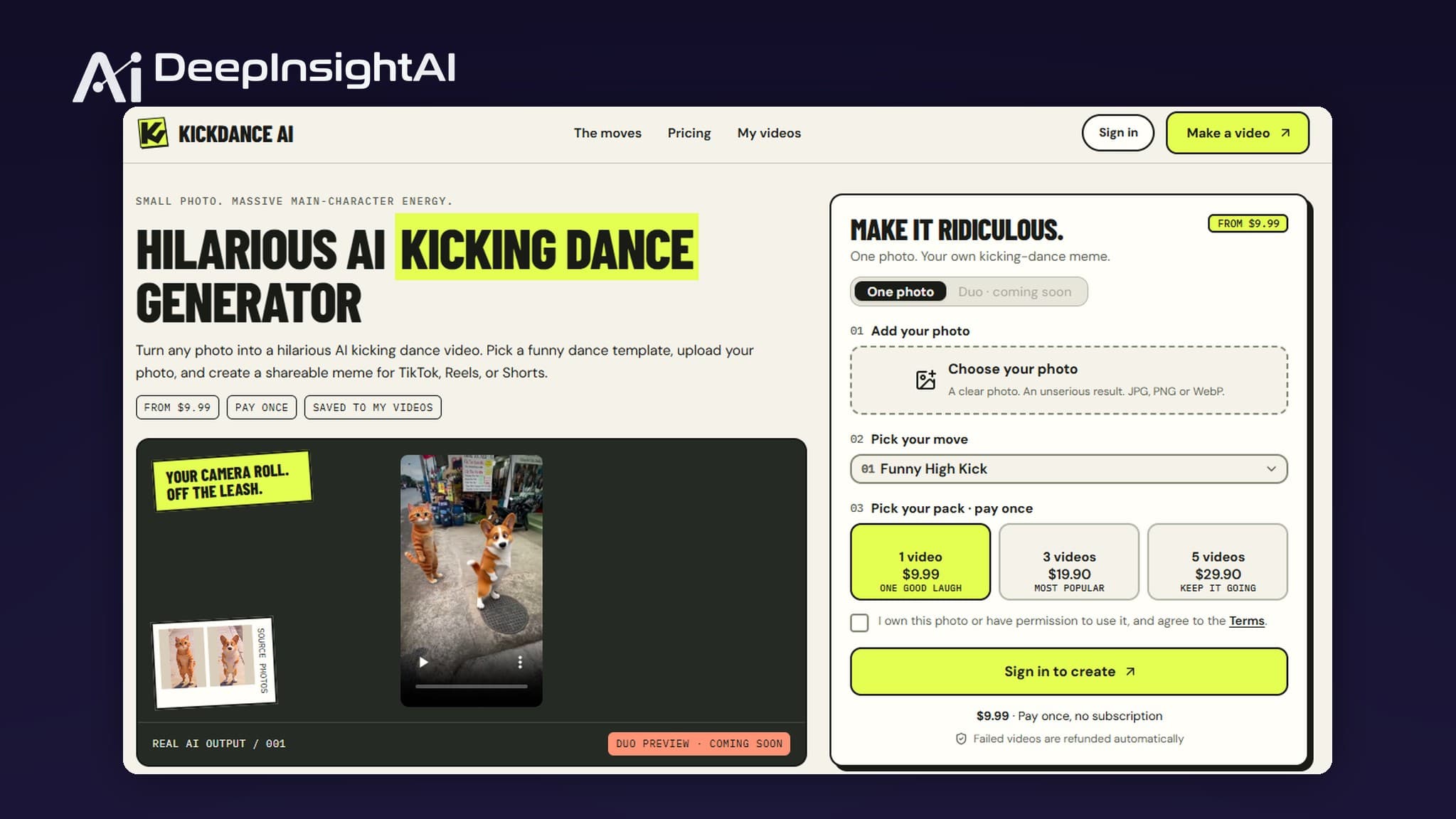
From Photos to Viral-Style Dance Videos: Meet the New AI Kicking Dance Generator
Hilarious AI Kicking Dance Generator turns static photos into entertaining kicking dance videos, built for social media users, meme enthusiasts, and…
Claude Carter
HappyHorse AI Video Review: Alibaba’s Cinematic AI Tool Shocks the Industry
the long-awaited happyhorse — HappyHorse-1.0 — has officially entered grey-scale testing. For anyone who has been closely watching the AI video space…
Claude Carter
HappyOyster Is Here: Alibaba’s Interactive World Model Changes AI Video Forever
Recently, a mysterious “happy horse” suddenly rushed to the top of the Artificial Analysis leaderboard. The AI circle was immediately filled with…
Claude Carter