Boston Dynamics Put Wheels on Atlas. That Is Not the Story You Think It Is
Atlas swapped its feet for skateboard wheels with one adapter. Behind the demo: thirty years of bipeds, zero units sold, and a controller that no longer depends on the leg.
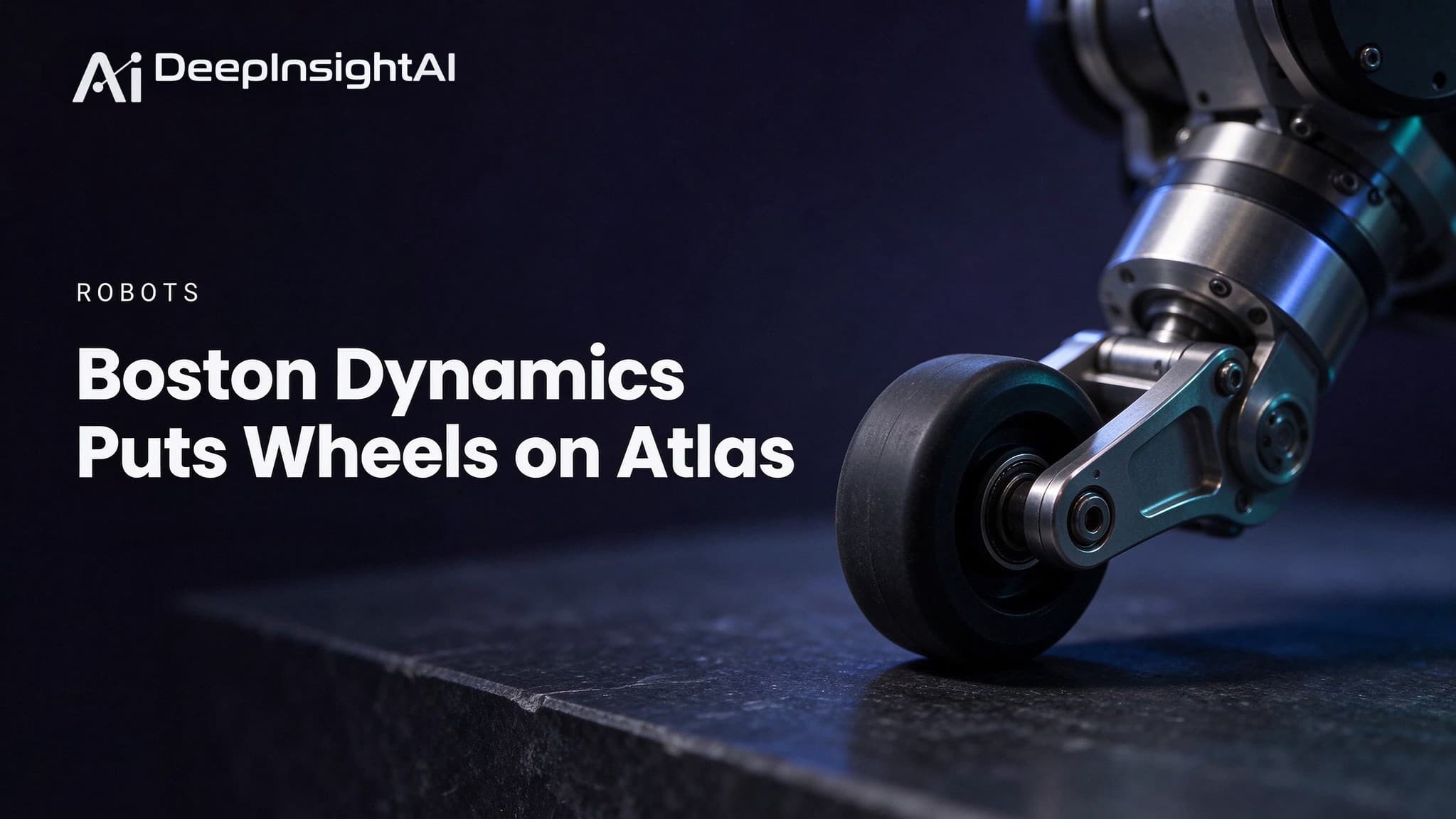
On November 9, 2026, Boston Dynamics posted a video under a minute long. The robot in it is Atlas, and it has no feet. An engineer bolted a custom adapter to each ankle actuator and mounted commercially available electric skateboard wheels. The result: a 1.9-meter, 90-kilogram machine with 56 degrees of freedom sprinting across flat ground, cutting sideways, stopping dead, and spinning a full airborne rotation before landing back on the wheels.
The only new hardware was the adapter. The feet were removed; nothing else changed. By Boston Dynamics' own estimate in its blog post, the labor involved was roughly equivalent to changing a bicycle tire.
The industry's first read was that Boston Dynamics was abandoning legs. That reading skips a fact: the company posting this video has been building bipeds for thirty-four years. It spun out of MIT's Leg Lab in 1992. BigDog, in 2004, was a hydraulic quadruped. The hydraulic Atlas at the 2013 DARPA Challenge had 28 degrees of freedom. It backflipped in 2017, ran parkour in 2018, and performed a gymnastics routine in 2019 that no other company has reproduced.
So why does the only company on earth that can make a biped backflip put wheels on it?
Thirty Years of Legs, Zero Sold
Boston Dynamics has never published a price for Atlas. The hydraulic version retired as a research platform. The all-electric version's 2026 production run is fully allocated, according to the company: the buyers are Hyundai's robot metaplant training center in Georgia and Google DeepMind, with external customer pilots pushed to early 2027.
The numbers on the company's other product line run the opposite way. Spot, the quadruped, has more than 1,500 public deployments at $150,000 to $375,000 each. Stretch, the wheeled base with a suction-cup arm, entered service in January 2023, moved its first million boxes in August, and had moved two million by year-end. DHL alone ordered more than 1,000. Commercial capability was never the missing piece.
Atlas is proof of this company's technical ceiling and proof of its commercial floor. Thirty years of humanoids, none sold. Six years of robot dogs, fifteen hundred sold.
Why do quadrupeds sell? Because when a quadruped falls, it stops working. When a biped falls, it falls on someone. And the standard working position of a biped is right next to a human.
The essential motion of a biped is to fall forward half a step at a time and catch itself. The difficulty concentrates in one place: at the end of every step the machine must simultaneously carry load, hold balance, and absorb impact, in a space with the least room, the most concentrated force, and the worst failure consequence.
Human cadence is roughly 110 steps per minute, which means shifting the body's full weight from one foot to the other every 0.55 seconds. Within a full gait cycle, stance phase is about 60% and swing phase about 40%, giving single-foot support roughly 80% of the time and double support only 20%. Every handoff requires recomputing the contact set, the admissible torque cone, and the center-of-mass trajectory. The controller is solving a hybrid dynamics problem in a few hundred milliseconds, and solving it wrong lands directly on those two ankle actuators.
Why Wheels Are a Dimensionality Cut, Not a Retreat
Wheels drop the order of the problem sharply. Four wheels stay on the ground the entire time, the support polygon does not change with time, and gravity is carried directly by the floor. The controller is now solving a trajectory optimization problem with constant constraints, and the same algorithm no longer needs branches prepared for every contact switch.
ETH Zurich's Robotic Systems Lab ran the controlled comparison. In a 2019 paper, Bjelonic and colleagues fitted non-steerable driven wheels to the ends of ANYmal's two leg pairs, leaving the chassis, actuators, and electronics untouched and holding total mass constant. On flat ground at 2 meters per second, mechanical cost of transport on wheels was 0.10; the same machine trotting was 0.59 — an 83% reduction. The speed ceiling rose from 1.5 m/s trotting to 4 m/s.
Same machine, same battery, six times the efficiency.
The 0.59 figure only shows its weight against a longer timeline. Human walking runs about 0.05. The biped Cassie runs about 0.7. DURUS, the efficiency-focused humanoid, targets close to 1. Boston Dynamics' own hydraulic quadruped BigDog, in 2004, was around 15.
The efficiency ceiling of legs is not in the motors. It is in having to re-launch every step. BigDog carried an engine a kilometer at dozens of times the energy of a wheeled vehicle of the same mass. Convert 0.10 and 0.59 into range on one battery and you get six times the distance.
Where the Engineering Actually Went
The real workload in this retrofit was on the software side.
Engineers replaced feet with wheels in simulation, then trained a whole-body controller with reinforcement learning. Steering, rolling, and braking have no hand-written logic. The demonstrations came from people: the team had humans perform rolling motions and captured them with motion capture, and the airborne spin reused previously recorded human jump data.
Simulation success rarely survives the move to hardware, because a virtual motor is not a real motor. So the team re-measured the behavior of the real actuators, wrote those characteristics back into the simulated motor model, retuned the control parameters, and the spin worked on the first attempt on the real machine.
The swap did not rewrite the control law. Feet off, wheels on, the controller took over. The hardest part of a biped is not in the legs; it is in the algorithm that keeps it from falling, and that algorithm has accumulated into a general-purpose component that can change skins. The control layer is abstract enough to no longer depend on what shape the end effector is.
A company that cannot walk steadily has no capacity for experiments like this. Removing the foot from the system and still producing an airborne spin is an ablation: what still runs without legs is what legs genuinely provided. Take the feet off and the controller remains. Put them back and not a line of it changes.
Walking is morphology. Not falling is the skill. Morphology can be swapped; the skill cannot.
Adding wheels to quadrupeds has been done many times in academia, but the 2019 paper's premise was a robot that could already trot. The wheels came after walking worked. Add wheels before you can walk and you have built a different chassis. Learn to walk first and then swap wheels, and that is a dimensionality cut.
Half the Actuators Only Keep It Standing
The industry agrees that money sits in the joints: actuators account for roughly 55% of bill-of-materials cost, and the two densest clusters are the dexterous hand and the legs.
So what is a leg worth? The industry has spent over a decade on this, and public materials offer two different hardware answers. One supply-chain breakdown puts legs at 26.6% of bill-of-materials, dexterous hands at 17.3%, shoulders at 14.3%, arms at 10.7% — close to seventy percent across four groups. A second, in dollars, collapses thigh, shin, and foot into one lower-limb line: 38.6% of roughly $55,000 in materials, or a little over $21,000.
The two figures differ by twelve percentage points. The difference is whether a six-axis force-torque sensor at the foot and eight linear actuators count as part of the leg. When the same product category can be quoted at half or double depending on the accounting, the ledger has no agreed convention yet, and anyone can make a leg lighter or heavier with their own definitions.
But the underlying control technology that legs represent is hard to price in hardware terms.
Ignore price and count joints instead, and the value becomes plain. Unitree's published manual lists the base G1 at 23 degrees of freedom, six per leg, twelve across both — more than half the machine. Half of that robot's actuators, once installed, do no work. They only keep it standing.
AgiBot sells both answers on one page. The bipedal Expedition A2 flagship is 169 cm, 69 kg, with a 700 Wh battery and 2-hour endurance, more than 40 active degrees of freedom, and 430 Nm peak ankle torque. Its published reliability data: a 5,100-hour walking test, a longest continuous run of 1,300 hours without anomaly, equivalent to 21 months in a typical scenario without a fall. The wheeled Expedition A2-W is 163 cm, 230 kg, four wheels with four-wheel drive, 22 degrees of freedom with two-arm coordination, 5 kg per arm, over 24 hours of standby, hot-swappable batteries. Same height, 3.3x the weight.
That gap is not a difference in design skill. It is a physical trade-off. A biped carries its entire mass on two legs and corrects balance continuously, so every extra kilogram cascades into actuators, joint structure, and control algorithms. It can only make itself light — 69 kg light, 2 hours of endurance light. A wheeled platform hands load-bearing and balance to four wheels and the floor, and much of that 230 kg converts directly into battery and structural stiffness.
This Was Not the First Time
In February 2017, Boston Dynamics released a robot called Handle: wheels at the ends of two legs, standing by dynamic balance, able to jump, able to carry boxes, far more agile on a warehouse floor than a biped.
The company later documented Handle's lineage on its technical blog. Its torso and arms came straight from Atlas. Engineers took a humanoid upper body, attached a wheeled leg, and eventually turned it into Stretch, the logistics machine that unloads containers and palletizes — the one that moved two million boxes in 2023 for DHL and Gap.
Parts flowed back and forth between the two product lines. Nine years ago, Atlas's upper body was lent to wheels. Nine years later, Atlas's lower body is stripped and given wheels. Same actuators, same control team, same modular design.
This company has done wheels twice. The first time, wheels were used to find a market. The second time, wheels were used to take a physical.
Different purposes, but wheels have never been a new direction here. They are a ruler for measuring how far legs have actually come. In 2017 the measurement said wheel-legs could become a product. In 2026 it says the controller can work independent of the leg. Unitree did something similar in spring 2026, putting wheels on its own G1 for field trials. The same experiment appearing at two companies in sequence says the whole industry is redoing the arithmetic on flat ground.
The content of that arithmetic is terrain. Stairs, thresholds, and rubble are the terrain features of human living space, and bipeds are the passport into it. Factory floors are flat. Warehouse floors are flat. Showroom floors are flat. On flat ground, everything a pair of legs buys you reduces to the shelf it knocks over while turning.
Customers Pay for Hours, Not Difficulty
Legs giving way to wheels is the clear differentiation trend in this deployment cycle, and the most direct evidence is in Chinese product catalogs.
AgiBot splits one upper body across two lines. The bipedal line goes to marketing and customer service, showroom narration, retail floor guidance, front desk and business inquiries. The wheeled line goes to flexible manufacturing load and unload, terminal insertion, and logistics transfer. One faces people; one faces a production line.
The bipedal Youth Edition was listed in August 2025 at ¥198,000, limited-time ¥168,000. The wheeled unit has no public price, but with one pair of leg actuators removed, its cost can only be lower.
Customers are stricter about price than the catalog is. Morgan Stanley published its second AlphaWise China humanoid survey on November 10: 64% of surveyed companies said they might adopt within three years, only two points above 2025's 62%, with expected deployment timelines pushed back about a year on average. Among potential adopters, only 18% are satisfied with current performance, down 5 points from last year, and 72% say the price must fall below ¥100,000 to be financially viable — up from 53% last year. But the overwhelming majority of those deployments go to flat floors, repetitive tasks, and per-station billing. Stairs are not involved.
Customers do not pay for difficulty. They pay for hours.
On November 11, the Beijing Municipal Bureau of Economy and Information Technology issued an action plan for the embodied-intelligence robot industry that turns a set of targets into hard requirements: rated payload at least 40% of self-weight, mean time between failures above 2,000 hours, annual failure rate below 10% for core motion components and end effectors, design service life above 5 years, and at least 4 hours of battery endurance under continuous operation. Two further figures target data and compute: more than 1 million hours of high-quality data collected across no fewer than 100 real scenarios, and more than 50,000 P of new dedicated embodied-intelligence compute capacity.
None of those five metrics assesses whether the machine looks human. They assess whether it stands, breaks rarely, lasts, and can work. At 90 kg, 40% is 36 kg — just above Atlas's 30 kg continuous payload line.
The Wheels Come Off on Their Own
Bipeds are the endgame form, wheeled-legs are the intermediate form, and the two statements do not conflict. The endgame form cannot pass a customer's acceptance test today. The current form will eventually be displaced by something better. So the account worth calculating is not which route is correct, but how much of the investment on this route dies if the route changes.
What Boston Dynamics put at risk here is one adapter and a few rounds of simulated training. The controller, the data, and the modular design all carry over. Even if wheels are abandoned tomorrow, that investment does not die.
There are three reversible directions. Make the leg a swappable part — this tire-change experiment already proves the modularity is sufficient, so a wheeled version becomes another pair of shoes for the same machine. Price by terrain class — one price for flat ground, another for unstructured terrain, instead of one quote sheet covering every site. And change the billing unit from units to effective hours, so customers pay for work done rather than joints installed.
Boston Dynamics itself says the wheeled Atlas is a research testbed, not a product, and that the data will feed back into the standard footed version. The next thing it plans to test is how the control system responds after an actuator fails. That sentence pulls the video back from demo to engineering floor, because failure testing is something you do just before production. A company intending to sell a product would not put its flagship through that at this stage. No failure data was published, the controller's long-term behavior on unstructured ground is undetermined, and there is no timeline for when the footed version reaches external customers.
Neither bipeds nor wheeled-legs have been decided by results. Technically, this argument is still a mortgage against belief. Difficulty is not bad news for the industry: hard means few companies will manage it, and the moment a scenario genuinely requires stairs, elevators, and thresholds, the people willing to pay for that scarcity will appear. When that happens, no more than three companies worldwide will be able to deliver a stable bipedal machine.
Wheels are the money you saved. Legs are the option you kept. Bipeds are not wrong, they are expensive. The day a leg's reliability can be written into a contract, the wheels will come off by themselves.
More in Robots
LDA-1B Explained: How “Garbage Data” Is Powering the Next Robot AI Breakthrough
The arms race around robot foundation models has just welcomed a new player. A joint team from Peking University, Tsinghua University, Galaxy…
Claude Carter
MotuBrain: The Universal Robot Brain Redefining Embodied AI
This isn’t a joke — it actually happened. A company known for video technology has built a general-purpose “brain” for robots. Different from…
Claude Carter

FlowWAM Tops WorldArena: Breakthrough in Spatial Intelligence and Physics-Aware AI
Recently, a series of developments across the industry have outlined a clear trend: embodied intelligence is moving away from pure “visual…
Claude Carter