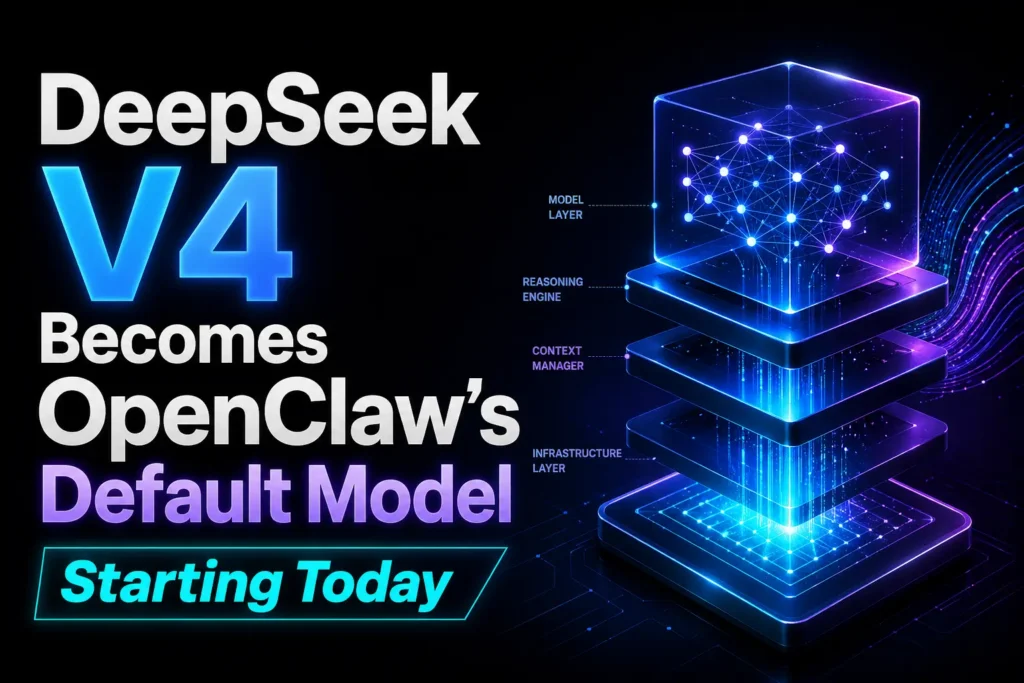
OpenClaw’s latest version has officially announced that DeepSeek V4 Flash has become the default large model. The world’s hottest open-source Agent framework with 250k+ stars has pushed China’s strongest open-source AI straight into the C position.
Today, OpenClaw officially brings in DeepSeek V4!
Once the new version OpenClaw 2026.4.24 was released, it immediately connected to the latest two versions of DeepSeek V4—
V4 Flash becomes the default large model, and V4 Pro has also gone live in the model library.
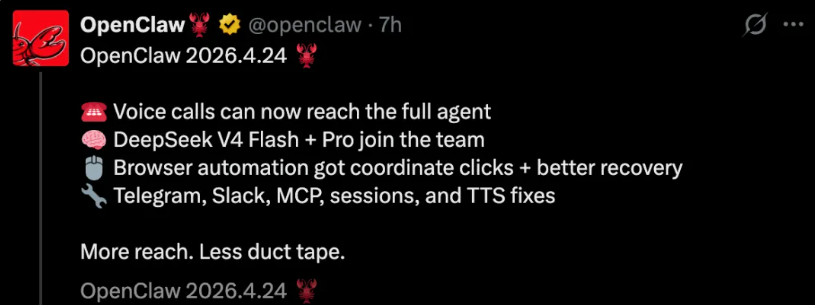

Starting today, every person around the world who updates OpenClaw, in the very first second after opening it, the brain talking with them is DeepSeek V4 Flash.
It can be said that the integration of DeepSeek V4 has become the biggest highlight of this OpenClaw update.
For a while, the whole internet became excited and eager to try it.
This time, OpenClaw also connected Google Meet, and real-time voice calls shocked the whole internet.
DeepSeek V4 Becomes the Default Model of OpenClaw
Two days ago, DeepSeek V4 dropped like a thunderclap. The new open-source king that the global AI circle had been waiting for finally landed.
OpenClaw connected to the “two versions” of DeepSeek V4 at the first moment, and also set V4 Flash as the default model.
“Lobster” personally pushed Chinese AI to the most central position.
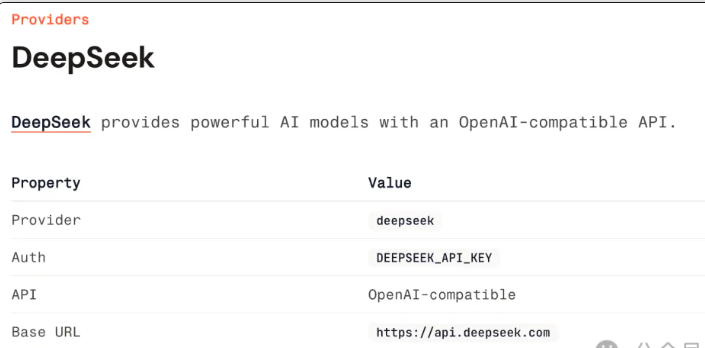
For ordinary users, the most direct change is that when they start using OpenClaw, they enter the DeepSeek V4 Flash route by default.
Feel the real weight of V4.
DeepSeek V4 Pro and DeepSeek V4 Flash
DeepSeek V4 Pro: 1.6 trillion total parameters, 49B activated parameters, MoE architecture, the world’s largest open-source model.
DeepSeek V4 Flash: 284B total parameters, 13B activated parameters, also MoE architecture. Smaller, faster, cheaper, but in Max mode, its reasoning ability almost catches up with the Pro version.
Both models support 1 million token context, and both use the MIT license to be fully open-source.
Image
This update also fixed DeepSeek’s thinking and replay behavior in multi-round tool calling.
Previously, when the Agent continuously called tools and switched session models, it could easily trigger provider replay check errors because reasoning_content was missing.
The new version fills in the related placeholder logic, making DeepSeek V4 Flash and DeepSeek V4 Pro more stable in long-chain tasks.
This kind of fix looks like engineering detail, but it is very critical for Agent products.
OpenClaw’s core scenario is no longer just chatting. More often, it lets the model continuously call the browser, meetings, voice, files, and plugins.
If model integration only stays at the text reply level, the value is limited. What truly affects the experience is whether it can hold up complex task chains.
Image
Lobster Makes Calls: Google Meet Becomes a Built-in Plugin
In this update, Google Meet was added into OpenClaw and became a bundled participant plugin.
The new version supports personal Google account authorization, explicit meeting URL joining, Chrome and Twilio real-time transport, and also supports paired-node Chrome, used for local audio and browser combined environments such as Parallels, BlackHole, and SoX.
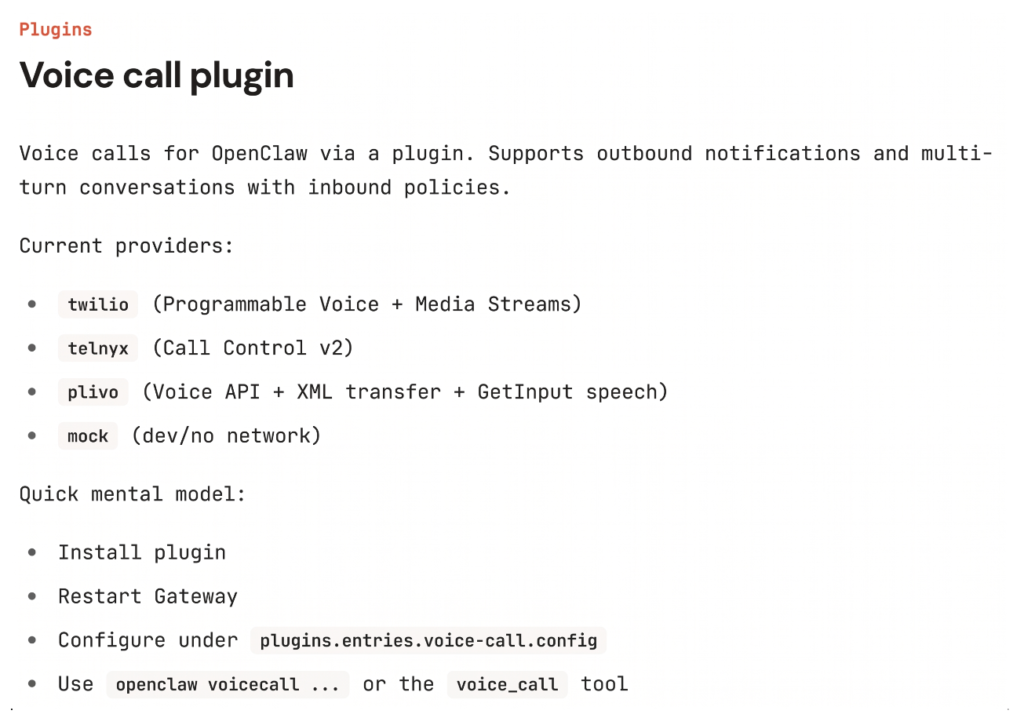
The more important change comes after the meeting ends.
OpenClaw can process meeting records, recordings, transcripts, smart notes, and participant conversations, and export them as Markdown or other types of files.
The system also supports finding the latest meeting record and scanning historical conference records.
This makes OpenClaw’s position in meeting scenarios move further forward.
What it takes on is not just transcription, but meeting entry, real-time participation, content deposition, and result lookup.
AI meeting assistants in the past mostly revolved around “recording.”
This time, OpenClaw turns meetings into a work node that can be called and managed by an Agent.
Image
Real-Time Voice Connects to the Complete Agent
Talk, Voice Call, and Google Meet can now all use the real-time voice loop.
The focus of this update is that real-time voice can call the complete OpenClaw Agent.
Through openclaw_agent_consult, questions in phone calls or meetings can be handed over to the backend Agent for processing. The Agent then calls tools, checks context, organizes the answer, and returns it by voice.
Image
The Voice Call plugin adds setup and a default dry-run smoke command, used to check whether Twilio or other providers are ready before real dialing.
On the Google provider side, Gemini Live real-time voice capability was added, supporting two-way audio and function calling.
Gateway/VoiceClaw also added a realtime brain WebSocket endpoint based on Gemini Live, and uses owner-auth for permission restriction.
This shows that OpenClaw is making voice a first-class entrance.
Outside the text box, phone calls and meetings are becoming the operating environment of the Agent.
Image
Browser Automation Continues to Fill Engineering Gaps
Browser automation is another key point.
The new version adds viewport coordinate clicks, supports managed automation and existing-session automation, and the CLI side also adds openclaw browser click-coords.
When web controls cannot be stably recognized, coordinate clicking provides a fallback plan.
The default action budget has been extended to 60 seconds, reducing cases where long waits are wrongly judged as failures.
Browser profiles also support separate headless settings. One profile can run headless, while other profiles are not affected.
Google Meet-related fixes also focus on browser stability.
The new version can reuse already opened Meet tabs, try to recover after browser timeout, and identify human blocking points such as login, permissions, and microphone selection.
These changes are not easy to become spreading points, but they affect whether the Agent can keep working.
Problems with browser Agents often happen around tabs, permissions, waiting time, and recovery mechanisms.
Image
Plugins and Model Architecture Become Lighter
OpenClaw is also reducing startup burden.
The model list has changed to a static directory, reducing registry enumeration during the default models list.
The model directory adds manifest-sourced model rows, allowing provider index, cache, onboarding, and listing to work without loading provider runtime.
The plugin side is also making similar adjustments: information such as modelCatalog, channelConfigs, and setup.providers is more exposed from the manifest, and the descriptor-only setup contract also becomes clearer.
As abilities such as Google Meet, Voice Call, PDF, Anthropic Vertex, Bonjour and others become plugins, loading all runtime at startup will slow down the system.
The new version moves descriptive information forward and pushes runtime dependencies backward.
This is a typical engineering trade-off: sacrificing a little early compatibility convenience in exchange for a lighter startup path and clearer plugin boundaries.
SDK Has Breaking Changes
This update also has one breaking change:
OpenClaw removed the Pi-only api.registerEmbeddedExtensionFactory(…) compatibility path.
After this, bundled tool-result rewrites need to use api.registerAgentToolResultMiddleware(…), and declare the target harness in contracts.agentToolResultMiddleware.
This will affect plugin developers.
The official side hopes tool-result transformation can stay consistent between Pi and Codex app-server dynamic tools, and the old interface needs migration.
Correspondingly, OpenClaw added a plugin compatibility registry and migration records, used to manage SDK, configuration, setup, and runtime deprecation paths.
Behind this is OpenClaw sorting out interface debt left by early rapid expansion.
Image
OpenClaw’s Direction Is Clearer Now
This update covers models, meetings, voice, browser, plugins, diagnostics, TTS, Slack, Telegram, MCP, and other modules.
DeepSeek V4 entering the default model path solves model capability;
Google Meet and Voice Call strengthen the collaboration entrance;
Browser automation, plugin lazy loading, and SDK migration fill in the engineering base for complex task runtime.
OpenClaw is moving from a chat product toward a workflow system.