el tan esperado happyhorse — HappyHorse-1.0 — ha entrado oficialmente en la fase de pruebas a escala reducida. Para cualquiera que haya seguido de cerca el ámbito de los vídeos generados por IA durante las últimas tres semanas, este nombre no le resultará en absoluto desconocido.
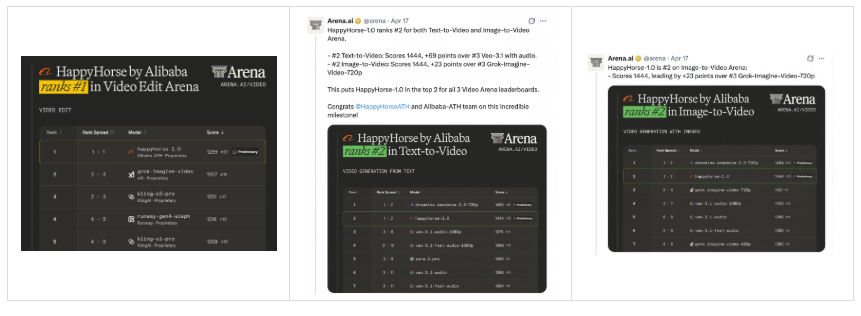
El 7 de abril, una misteriosa modelo anónima apareció discretamente en la clasificación de Video Arena de la prestigiosa plataforma Artificial Analysis. Tras tres días de especulaciones en Internet, Alibaba dio un paso al frente de forma repentina y “reivindicó” oficialmente a la modelo. Con una puntuación Elo de 1299, ocupaba el primer puesto en edición de vídeo en la clasificación de Arena, mientras que se situaba en segundo lugar tanto en la categoría de «texto a vídeo» como en la de «imagen a vídeo».
Ahora, este «caballo negro» que ha dejado boquiabierta a la comunidad mundial de la IA ha salido por fin a la luz. A partir de hoy, los creadores profesionales y los clientes empresariales de todo el mundo pueden registrarse y utilizarlo en la página web oficial de HappyHorse (www.happyhorse.cn) y la plataforma Bailian de Alibaba Cloud, mientras que los usuarios en general pueden probarla a través de la aplicación Qwen.
Calidad cinematográfica de HappyHorse: no se basa solo en filtros
Tras realizar pruebas prácticas, hemos constatado que happyhorse ofrece un rendimiento excepcional en los tiros de media y corta distancia.
Su capacidad para seguir instrucciones es extraordinaria y, a la hora de plasmar las emociones humanas, realmente cumple con creces. Le pedimos que generara un clip al estilo de un drama japonés, al estilo de Shunji Iwai: un chico y una chica universitarios, con un aire juvenil, el sonido de las cigarras, una sensación difusa de recuerdo, una iluminación suave y sobreexpuesta, planos a contraluz, cámara lenta y poca profundidad de campo.
En cuanto ves el vídeo, realmente se nota que es diferente de los vídeos generados por IA anteriores. Especialmente en el manejo de aperturas amplias y profundidad de campo reducida, la separación entre el sujeto y el fondo resulta natural y delicada. Los planos de medio primer plano transmiten una sensación de amplitud, llenos de tensión emocional. El control de la sobreexposición y la luz suave es moderado, lo que capta con gran precisión la estética de Iwai.
Se puede decir que este ritmo narrativo tan completo y esta superposición de emociones son, en definitiva, lo que da vida al “vídeo cinematográfico generado por IA”.
A continuación, le pedimos que generara un tráiler de película de suspense utilizando cinco planos emotivos. El resultado ya se acerca a los estándares de la industria cinematográfica. No da esa sensación de fragmentación propia de los vídeos cortos; al contrario, crea suspense y tensión emocional a través de un ritmo y una progresión constantes, lo que hace que tanto la narración como la expresión emocional se acerquen mucho más al lenguaje cinematográfico real.
Expresión emocional e interpretación de los personajes en HappyHorse
El videoclip que ha generado este grupo femenino coreano es complejo, elegante y de gran impacto visual, y combina la expresión emocional con la estilística, pareciéndose más a un auténtico videoclip comercial.
Por supuesto, happyhorse Aún no se han podido eliminar por completo los defectos de los modelos de vídeo basados en IA. Por ejemplo, en los últimos fotogramas, dos miembros del grupo se volvieron de repente idénticos.
Últimamente, la gente ha estado utilizando ChatGPT para dar nueva vida a viejas fotos de los años 90. Al combinarlo con HappyHorse-1.0, parece el toque final perfecto: los recuerdos desvanecidos cobran vida al instante, con gran viveza y realismo.
En general, ya se trate de escenas emotivas con mucho diálogo o de secuencias de acción de alta intensidad, es capaz de mantener una coherencia y una lógica impresionantes a lo largo de 15 segundos de transiciones entre varias tomas. Es precisamente ahí donde reside su calidad narrativa cinematográfica.
Aún más sorprendente es la solidez de la interpretación de los personajes. Por ejemplo, una niña que se recuesta con los brazos cruzados muestra un lenguaje corporal fluido y natural, sin ninguna rigidez mecánica. Destacan las microexpresiones: un niño arquea las cejas con sorpresa, evita el contacto visual y luego pasa a esbozar una sonrisa amarga con los labios apretados —unas claras capas emocionales que transmiten culpa e incomodidad—.
Incluso la decepción que se percibe en la voz temblorosa de la chica y la respuesta tardía y entrecortada del chico encajan a la perfección con la escena. Este tipo de diálogo fluido entre varios personajes reduce considerablemente la rigidez habitual de la IA, lo que hace que la interpretación se acerque más a una grabación real.
HappyHorse AI: Comprensión y narración en varias tomas
happyhorse Además, demuestra una sólida comprensión semántica y una gran capacidad para seguir instrucciones. Con solo una sencilla indicación de texto, es capaz de gestionar automáticamente la programación de múltiples tomas y la composición del guion gráfico.
Por ejemplo, a partir de un guion gráfico de nueve viñetas y una indicación, demuestra una comprensión impresionante. Es capaz de generar directamente una animación de 10 segundos con estilo «cel-shading», en la que se refleja con precisión la trama y se plasma plenamente el estilo visual.
Dicho esto, en los últimos segundos, siguen existiendo ligeras diferencias entre el fondo y la imagen de referencia original cuando la chica-gato enfunda su espada.
Estilos de HappyHorse: del anime a la estética tradicional china
Y sí, happyhorse puede adaptarse a una amplia variedad de estilos.
Desde el cine de Hong Kong, bañado en luces de neón, y las texturas granuladas de las películas retro, hasta la frescura reconfortante de la animación al estilo de Hayao Miyazaki y el encanto vivaz del 3D al estilo de Pixar; desde la estética de los espacios en blanco de la pintura en tinta diluida hasta el toque artesanal del origami y la arcilla: lo reproduce todo con precisión.
Uno de sus puntos fuertes son las escenas con un marcado carácter narrativo. Ya se trate de escenas de despedida al estilo antiguo, de alguien bebiendo en soledad bajo la luna o de un erudito escribiendo absorto en sus pensamientos, la intensidad emocional es rica y plena.
Tomemos como ejemplo una escena en la que un joven espadachín baila bajo las flores de melocotonero: desde el ritmo del movimiento de la cámara hasta los detalles, pasando por la atmósfera cromática y la transmisión de emociones, alcanza un nivel de perfección casi cinematográfico. La sensación de juventud queda perfectamente plasmada.
Incluso le pedimos que creara una animación al estilo chino similar a la escena de Chang’an, 30 000 millas donde Li Bai escribe “Jiang Jin Jiu”. El resultado transmite tanto la grandeza de la dinastía Tang como la desolación solitaria del poeta: una recuperación casi extrema del espíritu artístico clásico.
Su animación de estilo chino, generada por IA, realmente da “vida” a los bienes culturales, y no solo a nivel visual, sino también con alma. Los camellos «Tang sancai» parpadean, las máscaras de Sanxingdui mueven sutilmente la boca y las apsaras voladoras de Dunhuang salen flotando de los murales con cintas ondeantes y una gracia ingrávida.
Aun así, si se analiza con ojo crítico, se aprecian algunas imperfecciones; por ejemplo, cuando las apsaras se elevan en el aire, los movimientos de los brazos pueden parecer un poco poco naturales. A veces se necesitan varios intentos para conseguir resultados óptimos.
Escenas de acción y actuación dinámica en HappyHorse
Cabe destacar que, happyhorse También destaca en las escenas de acción.
En un duelo simulado entre dos espadachines, los movimientos son feroces y precisos, lo que refleja a la perfección esa estética oriental fría e intensa.
O pensemos, por ejemplo, en una secuencia de carreras a alta velocidad: la tensión que generan la velocidad y la adrenalina se lleva al extremo, lo que resulta realmente emocionante.
Edición de vídeos de HappyHorse: edita vídeos con una sola frase
Más allá de la generación, el segundo as de happyhorse es la edición de vídeo.
Ofrece dos modos de edición: edición en lenguaje natural V2V y edición con imagen de referencia SV2V.
La esencia de V2V es sencilla: “editar vídeo con una sola frase”. No hace falta abrir ningún programa de edición profesional. Basta con describir lo que quieres cambiar y la IA lo entiende y lo lleva a cabo.
SV2V te permite subir una imagen de referencia y sustituir sin problemas al sujeto de un vídeo, lo que te permite que tus personajes favoritos aparezcan en tus escenas.
Por ejemplo, en un vídeo original en el que aparece una niña corriendo por un sendero rural, al añadir una imagen de referencia de estilo, HappyHorse lo transforma al instante en una imagen “al estilo Ghibli”, con colores suaves e iluminación en cada fotograma.
Incluso puedes cambiar por completo el sujeto —convertir un perro en un gato— y cambiar la música de fondo, todo de una sola vez.
Incluso los ajustes más precisos son sencillos: “cambia el líquido ámbar del vídeo por un degradado rosa-morado con efecto de estrellas”.”
HappyHorse en la carrera de los vídeos con IA: un nuevo y potente competidor
Si analizamos el panorama general, el lanzamiento de happyhorse llega en un momento clave en el ámbito de los vídeos generados por IA.
El 25 de marzo, OpenAI cerró oficialmente el servicio completo de Sora. Lo que en su día se consideró el “límite máximo” de los vídeos generados por IA, se retiró debido a los elevados costes de computación y a las dificultades de comercialización.
Pero, en lugar de enfriarse, la carrera mundial por los vídeos generados por IA se ha vuelto aún más reñida: Veo 3.1, de Google, y Grok Imagine, de xAI, compiten ferozmente, mientras que los actores chinos están ganando terreno de forma conjunta.
Lo interesante es cómo entró HappyHorse en el mercado. En lugar de un lanzamiento a lo grande, optó por una estrategia del tipo “demostrar primero los resultados y revelar la identidad después”.
Aun así, por muy buena que sea la historia, lo que determina su éxito es el producto en sí.
HappyHorse-1.0 avanza en varios frentes clave:
- Una calidad visual que ya no delata que se trata de “IA”
- Capacidad narrativa en la que una sola indicación da pie a una historia completa compuesta por varias escenas.
- La sincronización audiovisual como parte intrínseca de la generación
- Capacidad de edición en la que el lenguaje natural sustituye a las herramientas profesionales
Precios de HappyHorse: una excelente relación calidad-precio para los creadores
Para la mayoría de los creadores, el factor más práctico es la relación calidad-precio.
El happyhorse La página web oficial ofrece plantillas creativas listas para usar y ajustes preestablecidos de la comunidad, lo que facilita dar los primeros pasos. Además, los precios son competitivos: los nuevos usuarios reciben créditos gratuitos.
Precios estándar:
- 720p: 0,9 RMB/seg.
- 1080p: 1,6 RMB/seg.
Con descuentos por suscripción:
- 720p: desde tan solo 0,44 RMB/seg.
- 1080p: desde tan solo 0,78 RMB/seg.
En el mercado actual, este precio tiene un gran impacto.
Y lo que es más importante, HappyHorse ha puesto en marcha el “Programa de los 100 mejores creadores”, en el que invita a los aficionados a la AIGC de todo el mundo a probarlo de forma gratuita.
HappyHorse Future: de juguete a herramienta creativa real
Si se tienen en cuenta todas sus prestaciones, junto con unos precios competitivos, happyhorse apunta en una dirección clara: el vídeo generado por IA está pasando de ser un “juguete” a convertirse en una “herramienta”.”
En 2026, la competencia ya no se centrará en quién tiene las especificaciones técnicas más avanzadas, sino en quién puede ser realmente útil para los creadores.
Con la llegada de HappyHorse, surge una nueva posibilidad: ofrecer una calidad propia del cine a un precio asequible.
Este “caballo feliz” acaba de empezar a correr.